Blog
The Field Has a New Front Door
September 17, 2026
We used to have a brochure. This month we built a door.
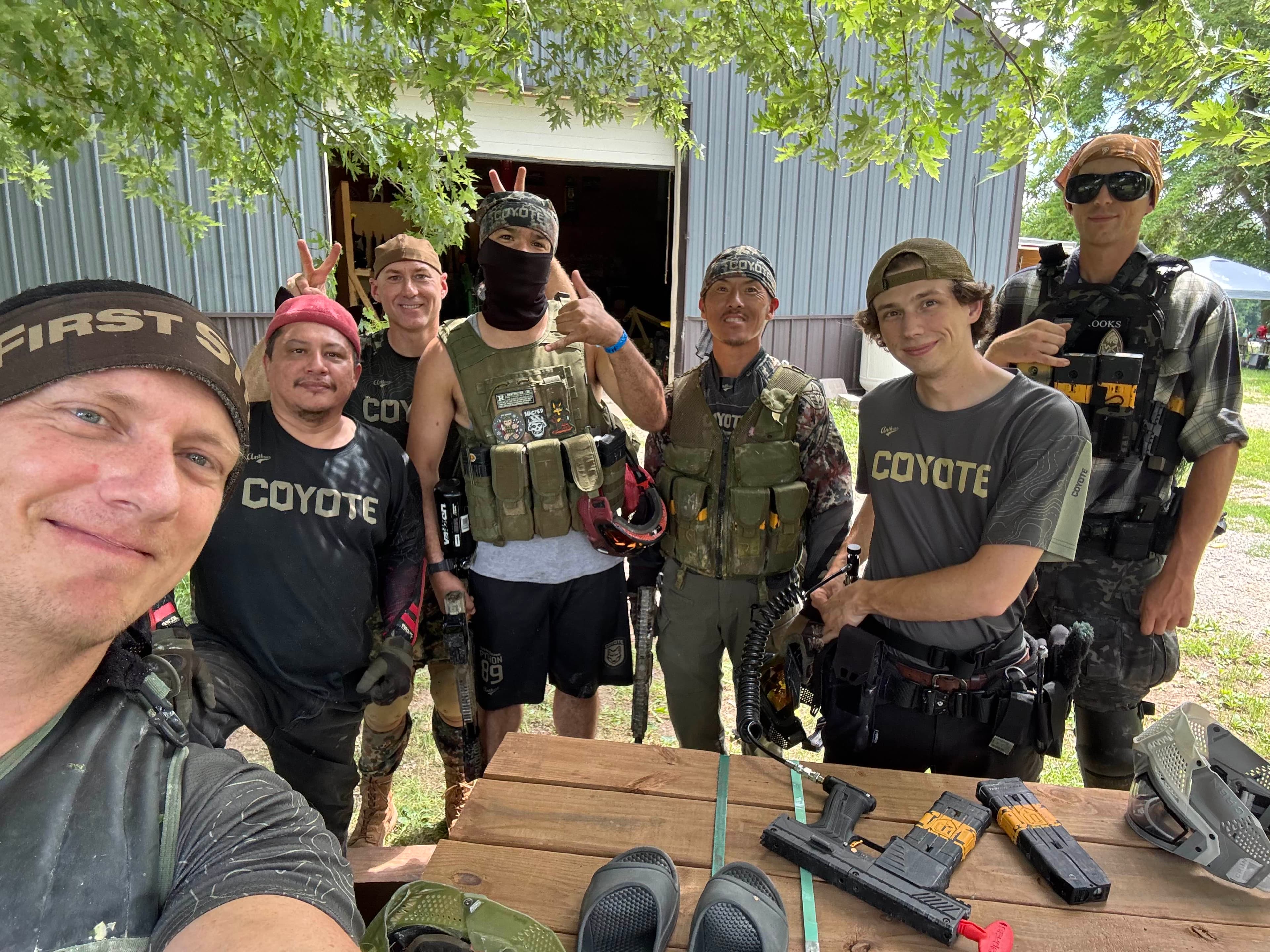
Editorial by Courtny Cotten | Field Owner
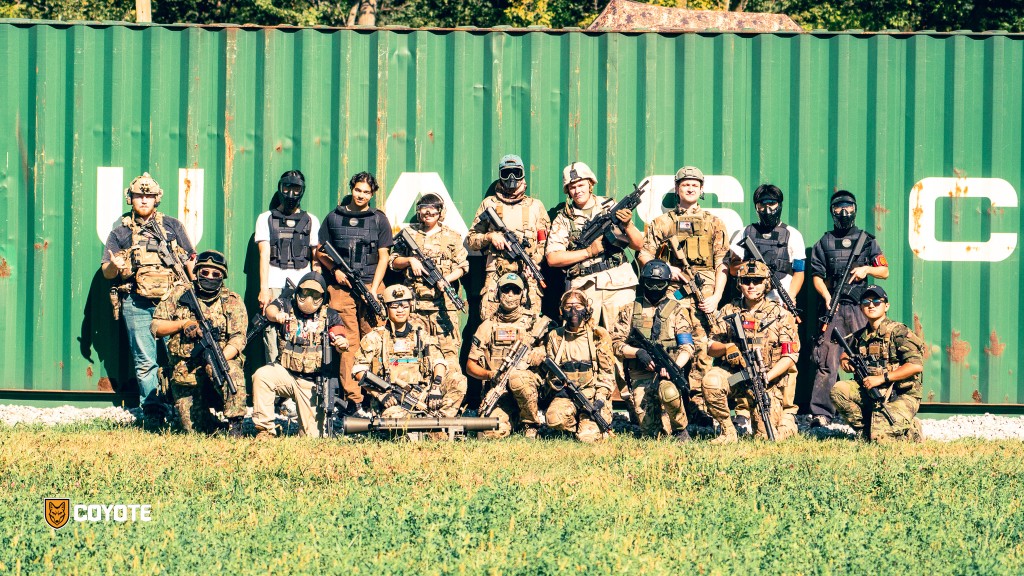
On a Saturday in June of 2024, on Father's Day, a small crowd stood on a stretch of Indiana pasture and watched a field open. There were rental markers on plastic tables, a hand-lettered sign, and a line of cars snaking down the county road. A father knelt to buckle a mask on a child who had never worn one. A group of teenagers who had driven in from Purdue stood in a loose ring, doing the polite arithmetic of who to shoot first. Nobody, that morning, was thinking about a website.
Two years later, the website is why I am writing.
The sociologists have a phrase for a place like this one. Ray Oldenburg called them "third places," the spaces that are neither home nor work but where a community actually happens: the barbershop, the diner, the bowling alley, the church basement where the folding chairs are already out. He argued, forty years ago, that American life was quietly hollowing out because those places were disappearing. He was, if anything, early. What has come after the third place is not a fourth place. It is a screen. A feed. A group chat that mistakes itself for a room.
I do not say this as a man selling paintball. I say it as someone who has watched, from the inside, what the last two decades of the internet have done to the way we gather. I have worked in software since 2005, including a long stretch at Microsoft, and I have shipped products I am proud of. This Field is my favorite project so far, and easily the most challenging one. It is also, I think, the most honest thing I have built. It insists on bodies. It insists on weather. You cannot download a Saturday morning on a Battlefield.
The problem, until this month, was that our website did not quite know what the Field was for. It was, in the polite terminology of the trade, a brochure. It described the place. It did not particularly help you get to it. If you wanted to book a birthday party, you filled out a form and hoped. If you wanted a ticket to a scenario game, you hunted through a Facebook post from three weeks ago. If you had questions, you called the phone. The gap between the community we were building on the Battlefield and the front door we were offering online was, I came to feel, a small betrayal of the whole idea.
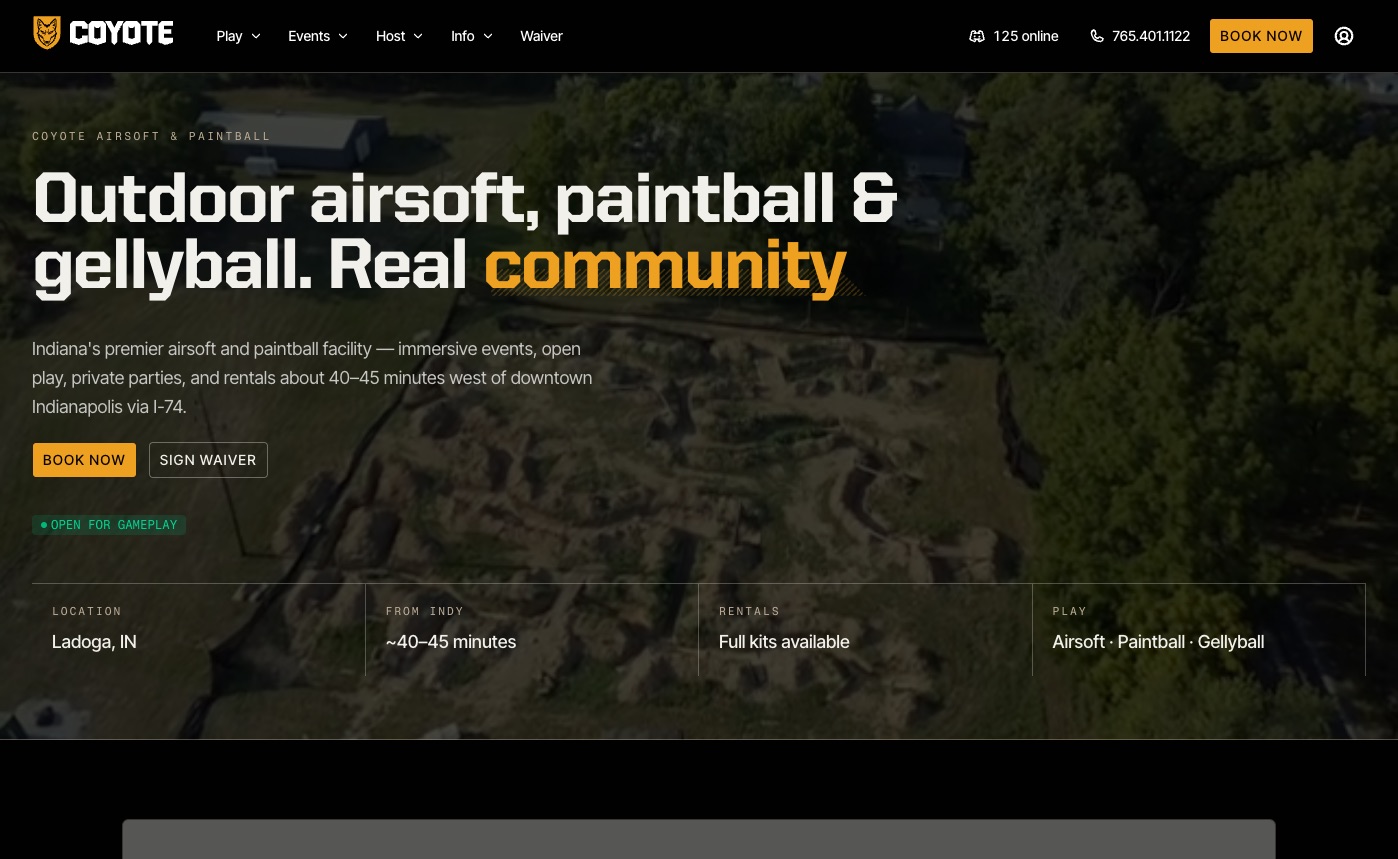
So we rebuilt it. coyoteforce.com, as of this month, is not a brochure. It is the door.
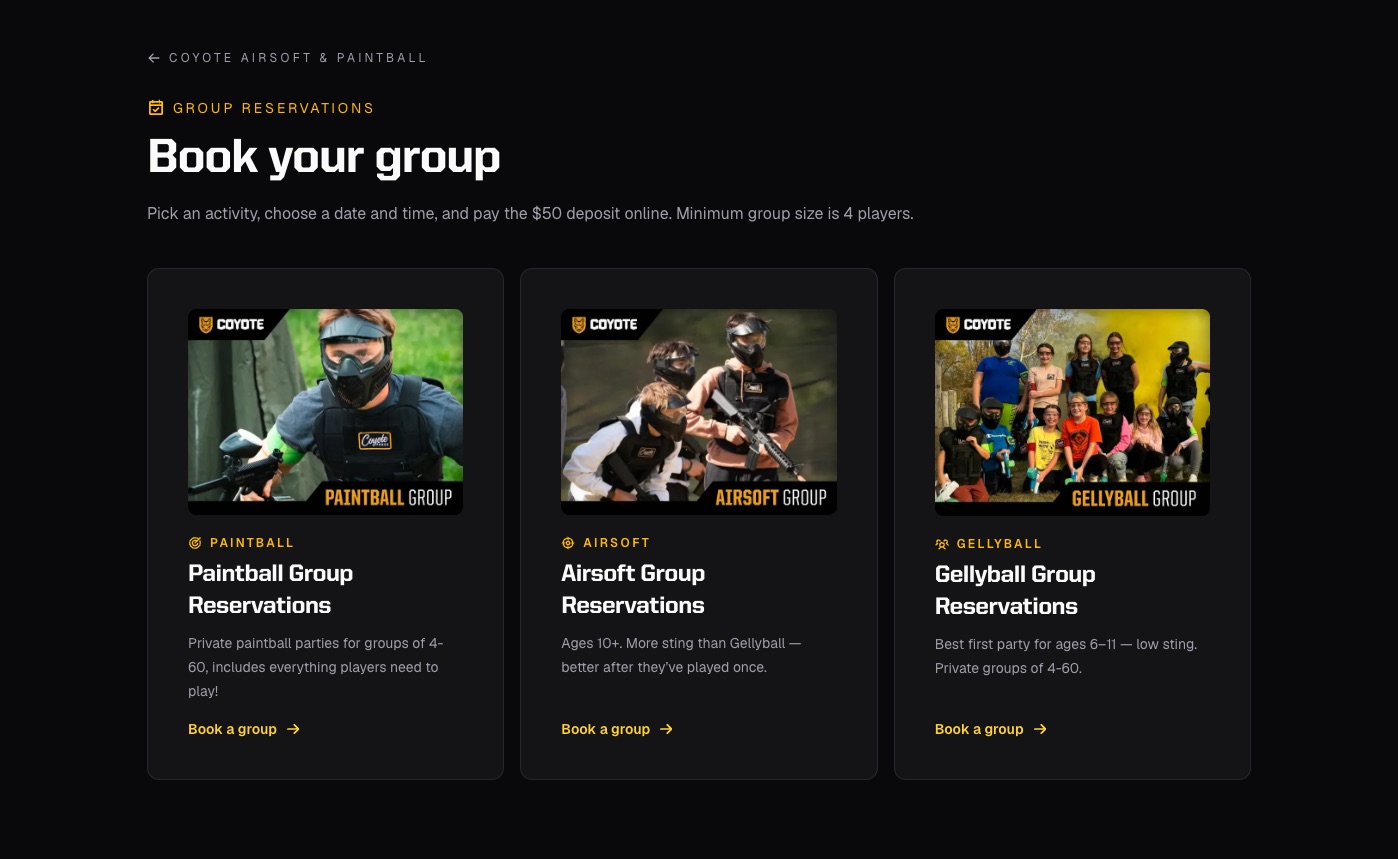
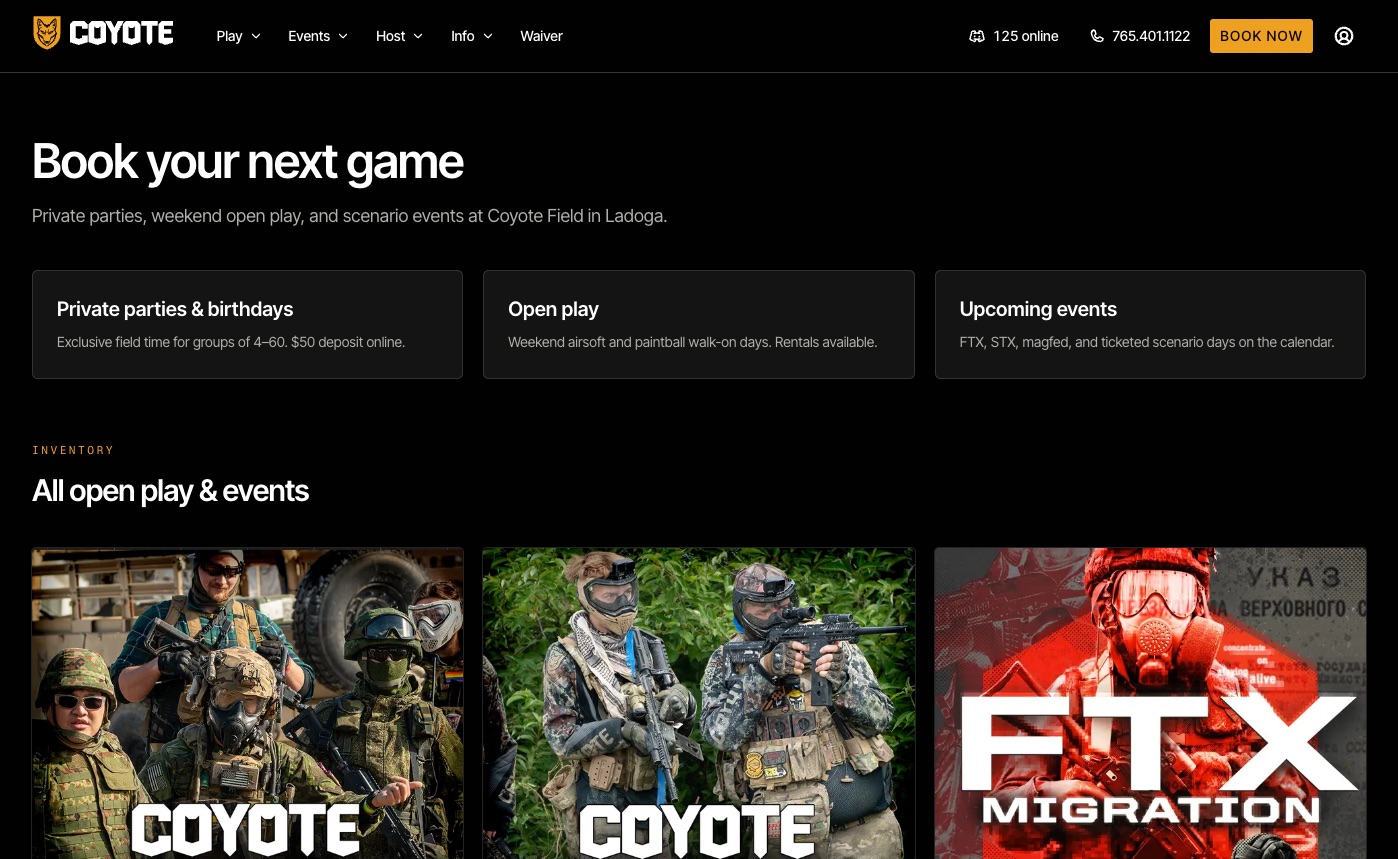
The first thing the door has to do is let a stranger book the Field. Private groups pick paintball, airsoft, or gellyball, pick a date, pick a headcount, and hold the slot with a fifty-dollar deposit. The rest is billed per player at check-in, so a group that shrinks by two on Friday night does not overpay on Saturday morning. What arrives in your inbox afterward is, to me, the small victory of this whole project: a confirmation with a link that lets you reschedule or cancel yourself, a calendar invite you can drop onto a phone, and a link to the waiver so that the parking lot is not, as it has too often been, a clipboard scrum.
The tickets work the same way. Open play and scenario events, which for years lived as flyers pinned to the top of a Facebook page, now live at a single URL, on a grid that updates itself. This month that means an FTX called Migration on September 26, with three factions and a printed day sheet. Next month, Kraken Tactical brings its Operation Undertow milsim to our Field. In December we host the first gathering of the Coyote Combat LARP, a foam-weapon melee day on a battlefield we built for it. These events have real pages now. They have real tickets. They are not, any longer, an invitation you saw once and forgot.
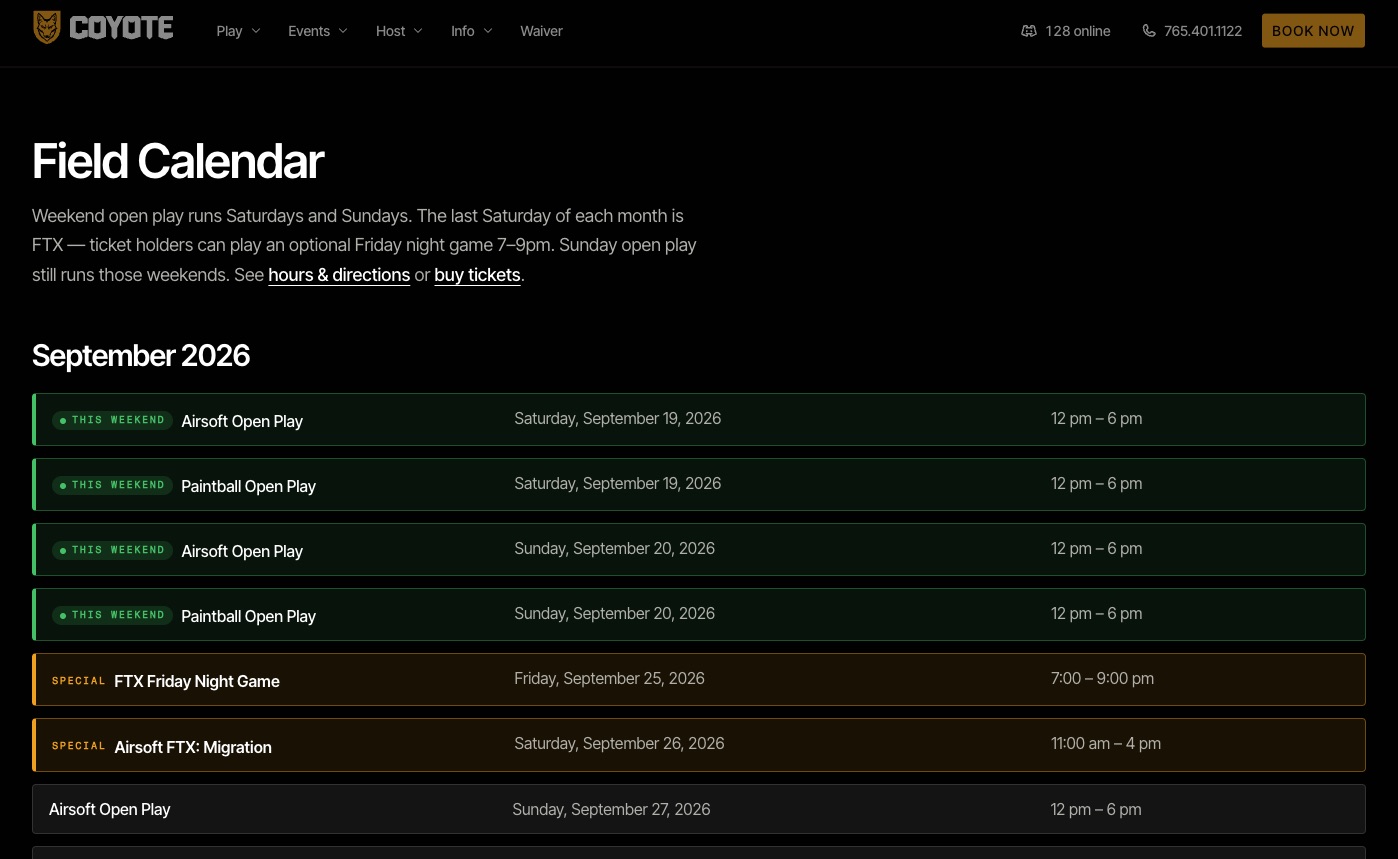
Tickets are how you buy a Saturday. The field calendar is how you see the month. Weekend open play, FTX callouts, and this weekend sitting in green, all on one list, so you are not reconstructing the schedule from a Facebook post at eleven on Friday.
What has surprised me most, in the short time we have been open, is what the community has done with the games when we get out of the way. A scenario, on paper, is a set of rules. A faction, at first, is a colored armband. What has grown, and grown faster than I know how to account for, is the running mythology that sits on top of all of it. Names that mean something now. Allegiances that hold across a summer. Betrayals that people are still talking about months later, and that carry consequences at the next game. A commander who lost the last round arriving at the next one with a plan, a following, and a case to make.
We did not write any of that, and I want to be honest about it. We built a Field and a set of games. The community built a world. The COMMANDER Series, which we launched this year, is the closest we have come to naming the thing out loud: a long-running campaign in which the people who lead factions on the Battlefield are recognized as the ones who are actually authoring the history of the place. Most weekends, someone shows up in a patch we did not design, for a faction whose backstory we did not invent, ready to fight a rival they chose. You cannot, in any meaningful sense, own that as an operator. It is theirs. Our job is to keep the door open and the ground fair.
The shop is the honest exception. It is not stocked yet, and I would rather tell you that than dress an empty aisle. Patches are first in line, the small, cloth act of belonging that a scenario team pins to its kit. After that, the things you actually consume on a game day: grenades, BBs, paintballs, green gas. Those will not be shipped. They will be reserved, paid for with your event entry, and set aside for pickup at the Field on the day you play. It is the kind of quiet convenience that is, I have come to believe, the whole point of a website that respects the physical world it sits next to.
Which brings me to the piece I am, admittedly, most excited about.
When we designed the account system, we did the responsible thing first. You can sign in with Google. You can sign in with an email code. You can, if you prefer the old ways, choose a password. You can also skip the whole business and check out as a guest, which many of you will, and that is fine. But the account we care most about is the one you probably already have. You can sign in with Discord.
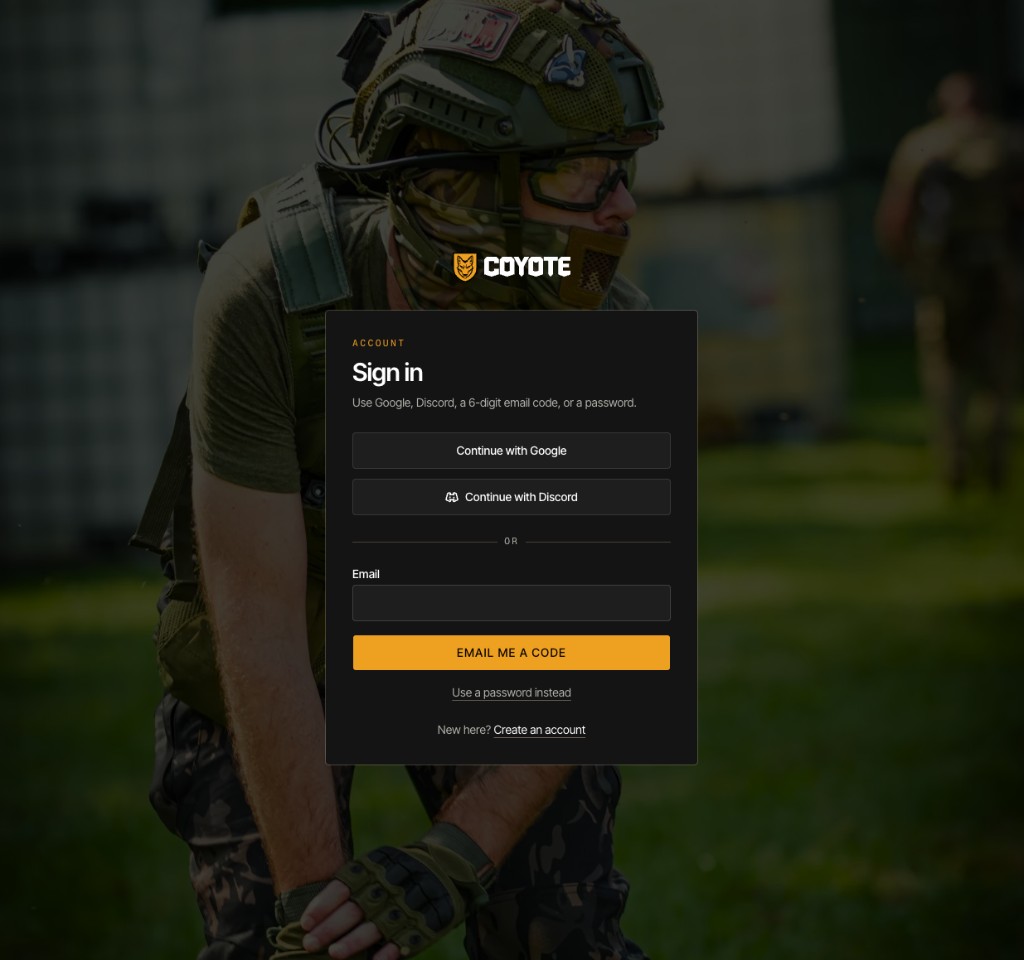
This will sound small. It is not. The Indiana airsoft community, which is real and stubborn and largely invisible to the algorithmic internet, already lives on Discord. It is where the afterglow of an open-play Saturday happens, where kit photos are traded, where a shy fifteen-year-old asks whether his rental mask fogs and receives, within an hour, seven serious answers. For years the site and the server were two different lives. Now they are one login. What I am building next, and I will not put a date on it because dates on the internet are lies, is a way for that community to be recognized in the place where the tickets are sold. Not a punch card. Not a leaderboard of purchases. Something more like: the people who show up, over and over, for this Field are its actual owners, and the website should know it.
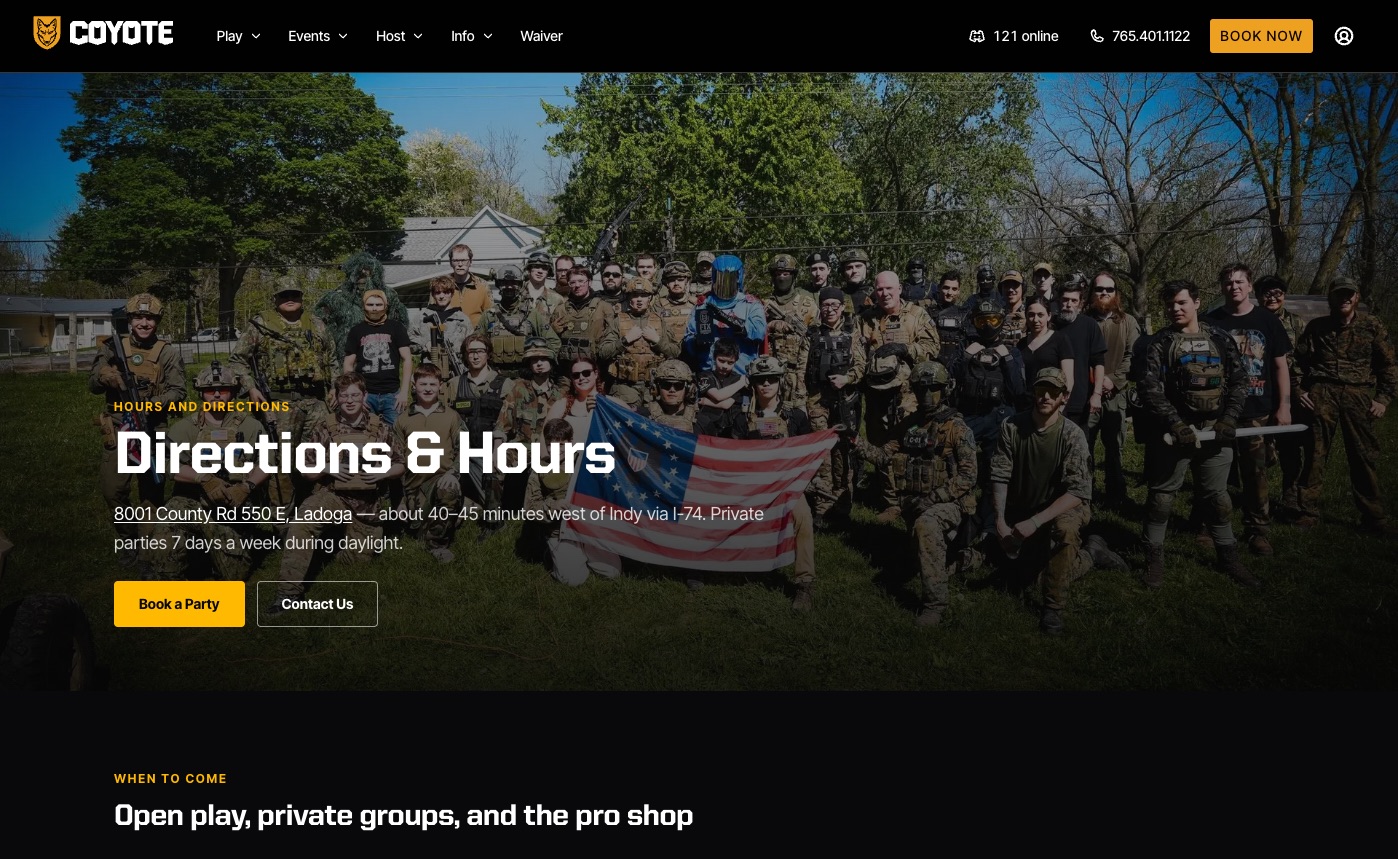
The rest of the door is unglamorous, which is how you can tell it was designed by someone who actually opens it. There is a map with real hours at coyoteforce.com/hours-directions, because the Field is fifteen minutes from the highway, forty-five minutes from downtown Indianapolis, and Google Maps has, on more than one occasion, tried to route people through a soybean field. There is a Text us link, because the phone still works but the phone is not always the way. There is a waiver button on the homepage, because the best time to sign a waiver is not when your kid is already holding a mask.
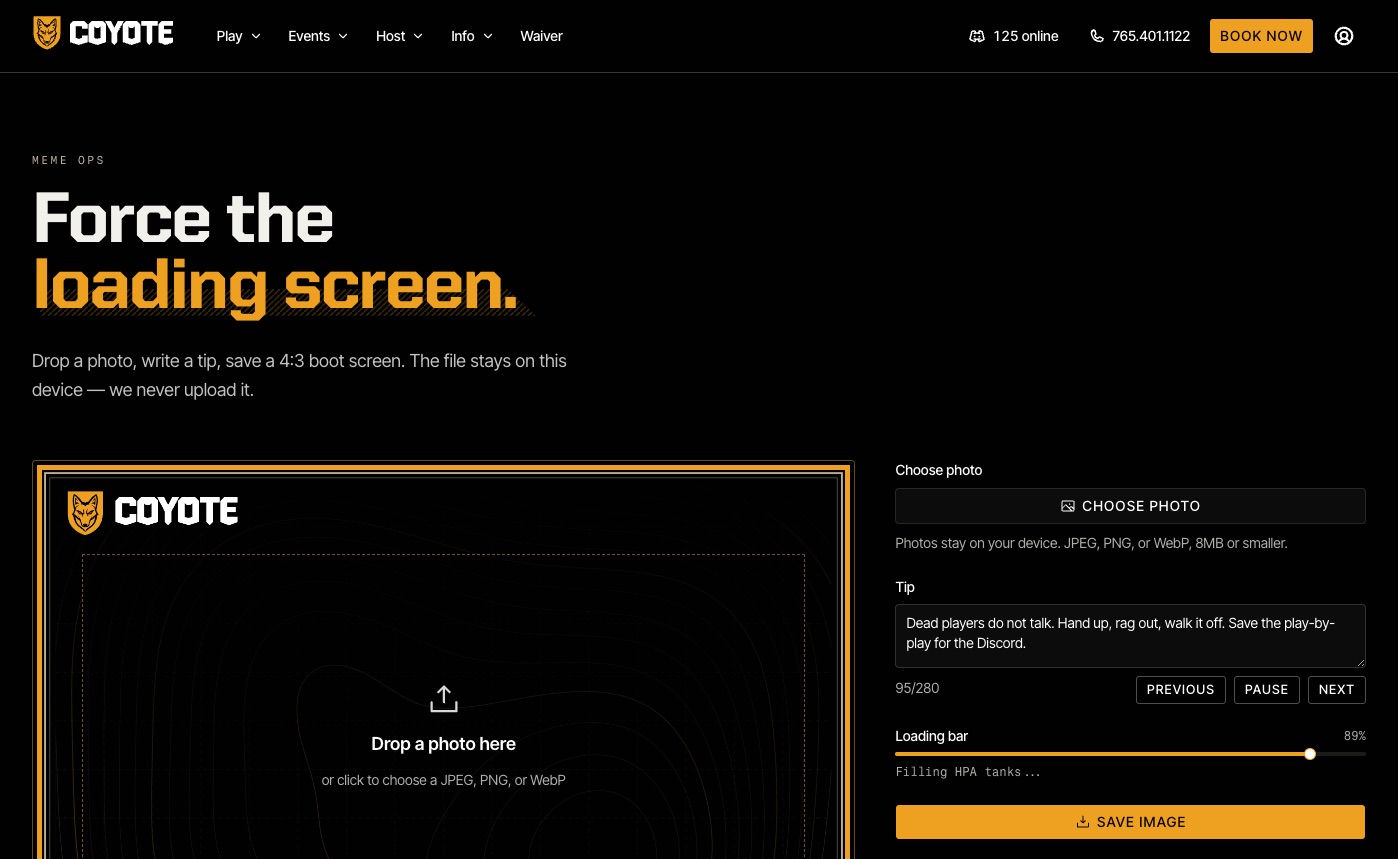
And, because we are not entirely serious people, there is a loading-screen generator, which will not get you to the Field faster and will, I hope, make your group chat marginally better.
I do not think a website can save the third place. I do not think anything can, exactly, because the third place is not a technology problem. It is a habit. It is the quiet decision, on a Saturday morning, to leave the house and go do something with other bodies. What a website can do is get out of the way of that decision. It can turn a brochure into a door. It can put the calendar in one place and the tickets next to it and the waiver where you cannot miss it and the community, at last, in the same building as the checkout.
If you have been looking for a place to play, to run a birthday that is not another bounce house, or to find your people on a Saturday on a Battlefield, the door is now open.